
Roman Letter Chart
Roman numerals use just seven letters — I, V, X, L, C, D and M — combined by a few simple rules. This chart shows every number from 1 to 100 and the hundreds up to 1,000, colour-codes the building blocks, and lets you build any number from 1 to 3,999 step by step. A quick quiz helps the patterns stick.
- Free to use
- No sign-up
- Runs in your browser
Roman numeral chart and builder
Quiz
Roman Numeral Charts
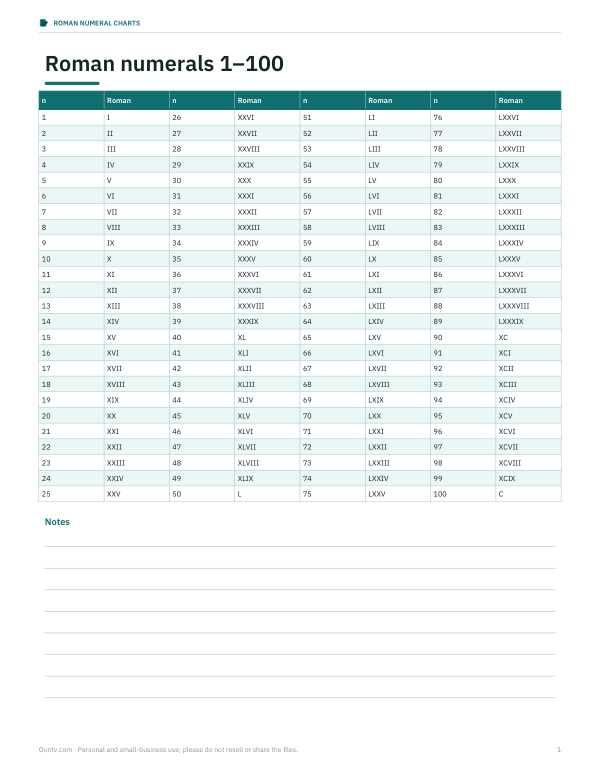
Printable Roman numeral charts (1–100, and to 1,000 by tens and hundreds), a colour-coded letters poster, practice worksheets with answers and a clock-face worksheet.
- Chart 1–100 (PDF)
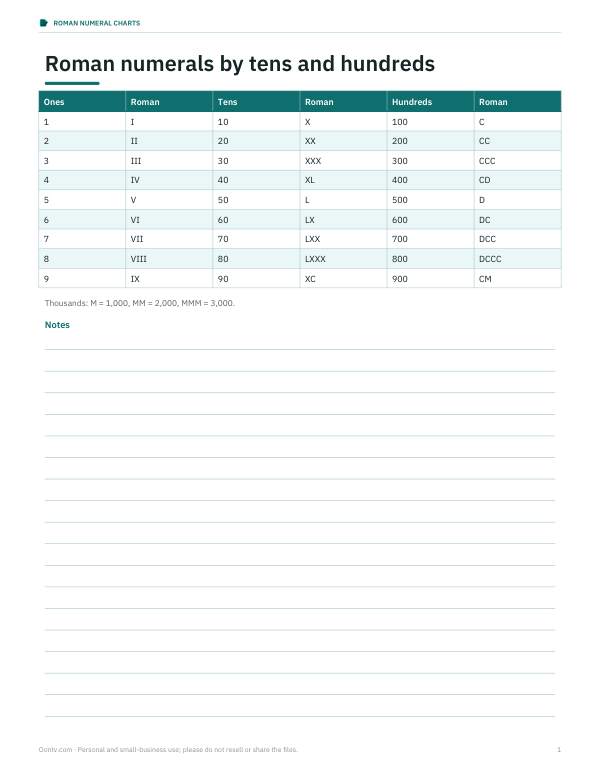
- Tens & hundreds (PDF)
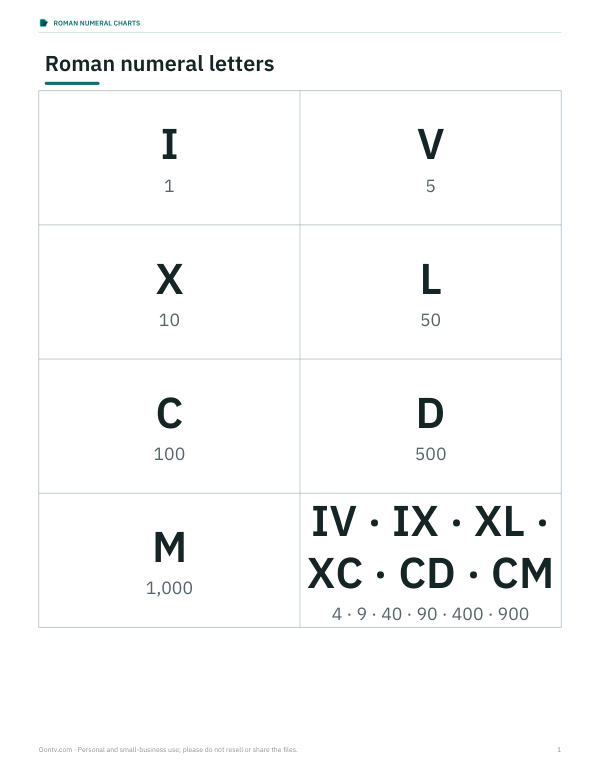
- Letters poster (PDF)
- Practice worksheet (PDF, DOCX)
- Clock worksheet (PDF)
Formats: PDF, DOCX. Instant download after payment (link valid 72 hours, up to 5 downloads). AI-assisted: the templates were drafted with AI help and reviewed and laid out before publishing.
$5.00 USD, one-time 5 files · about $1.00 each
- Instant download
- 7-day refund
- Secure checkout by Stripe
7-day money-back guarantee. Full refund within 7 days of purchase, even after you download.
Free sample: Clock Face Worksheet (PDF, 58 KB)
Full refund within 7 days — see the refund policy and license.
Free printables
Single sheets you can print right now, no sign-up. The full pack adds every sheet in one download plus the editable files.
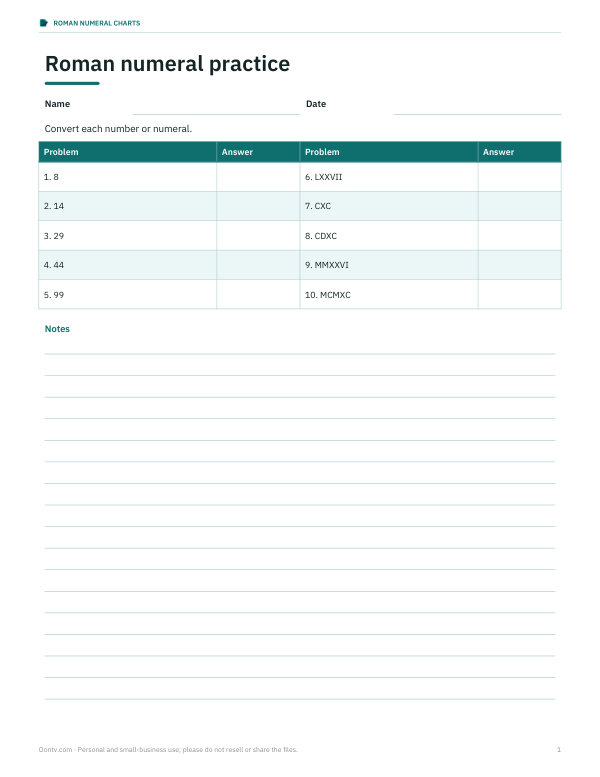 Printable Roman Numeral Practice Worksheet
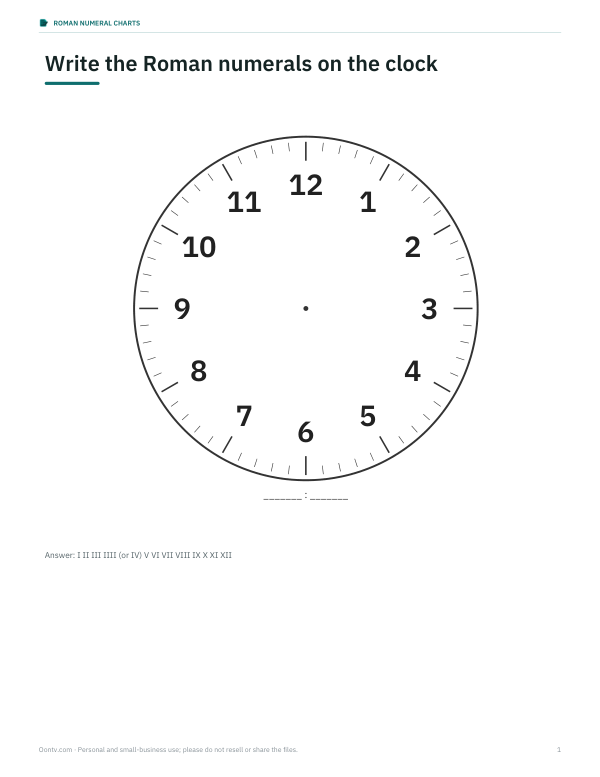 Printable Roman Numeral Clock Worksheet
The seven Roman numeral letters
| Letter | Value | Memory hint |
|---|---|---|
| I | 1 | One finger |
| V | 5 | An open hand (thumb and finger make a V) |
| X | 10 | Two Vs, one upside down |
| L | 50 | |
| C | 100 | Latin centum — as in century |
| D | 500 | |
| M | 1,000 | Latin mille — as in millennium |
A popular memory sentence for the order is “I Value Xylophones Like Cows Do Milk”.
The rules
- Write letters from largest to smallest and add them: XVI = 10 + 5 + 1 = 16.
- Don’t repeat a letter more than three times in a row: 3 is III, but 4 is not IIII (except on some clock faces).
- A smaller letter before a larger one is subtracted — but only in six pairs: IV (4), IX (9), XL (40), XC (90), CD (400), CM (900).
- V, L and D are never repeated and never subtracted.
- Write each place value separately: 49 is XLIX (40 + 9), not IL.
Roman numerals 1 to 30
| Number | Roman | Number | Roman | Number | Roman |
|---|---|---|---|---|---|
| 1 | I | 11 | XI | 21 | XXI |
| 2 | II | 12 | XII | 22 | XXII |
| 3 | III | 13 | XIII | 23 | XXIII |
| 4 | IV | 14 | XIV | 24 | XXIV |
| 5 | V | 15 | XV | 25 | XXV |
| 6 | VI | 16 | XVI | 26 | XXVI |
| 7 | VII | 17 | XVII | 27 | XXVII |
| 8 | VIII | 18 | XVIII | 28 | XXVIII |
| 9 | IX | 19 | XIX | 29 | XXIX |
| 10 | X | 20 | XX | 30 | XXX |
Tens and hundreds
| Tens | Roman | Hundreds | Roman |
|---|---|---|---|
| 10 | X | 100 | C |
| 20 | XX | 200 | CC |
| 30 | XXX | 300 | CCC |
| 40 | XL | 400 | CD |
| 50 | L | 500 | D |
| 60 | LX | 600 | DC |
| 70 | LXX | 700 | DCC |
| 80 | LXXX | 800 | DCCC |
| 90 | XC | 900 | CM |
Learn these two columns and the ones (I to IX) and you can write any number up to 3,999 by joining the pieces: 1,987 = M + CM + LXXX + VII = MCMLXXXVII.
Worked example
To write 444: 400 is CD, 40 is XL and 4 is IV, so 444 = CDXLIV. To read MCMXCIX, split it into place values: M (1,000) + CM (900) + XC (90) + IX (9) = 1,999. The builder above shows this breakdown for any number, colour-coding each letter.
Common mistakes
| Wrong | Right | Rule |
|---|---|---|
| IIII (4) | IV | No letter four times in a row (clocks are the exception) |
| VV (10) | X | V, L and D are never repeated |
| IC (99) | XCIX | I can only be subtracted from V and X |
| IL (49) | XLIX | Subtract only one step: I from V/X, X from L/C, C from D/M |
| VX (5) | V | V is never subtracted |
| MCMC (2000) | MM | Write place values separately |
Reading long numerals quickly
- Scan from left to right.
- Whenever a letter is smaller than the one after it, treat the pair as one subtraction (CM = 900).
- Group the letters into thousands, hundreds, tens and ones.
- Add the groups: MMXXIV = 2,000 + 20 + 4 = 2,024.
With practice, you’ll recognise common chunks — CM, XC, IX — at a glance, which makes film credits and building dates easy to read.
Teaching Roman numerals
- Start with I, V and X and numbers to 20; add L and C later.
- Use matchsticks or lolly sticks to build numerals.
- Look for Roman numerals on clocks, book chapters and buildings around you.
- Play the quiz in pairs: one writes a number, the other converts it.
- Practise with birth years and the current year — children love writing their own.
A little history
Roman numerals developed from tally marks used in ancient Italy and were the standard way to write numbers across the Roman Empire and in Europe for more than a thousand years. They were gradually replaced by Hindu–Arabic numerals (0–9) from the late Middle Ages, because place value and zero make arithmetic far easier. Romans themselves were not always consistent: IIII and VIIII appear in ancient inscriptions alongside IV and IX.
Where you still see Roman numerals
- Clock and watch faces.
- Chapter numbers, prefaces and outlines (i, ii, iii).
- Names of monarchs and popes — Elizabeth II, Louis XIV.
- Film copyright years and sporting events.
- Building cornerstones and monuments.
- Tattoos and engravings of important dates.
Lowercase Roman numerals
Lowercase numerals (i, ii, iii, iv…) are common for page numbers in book front matter and for sub-points in outlines and legal documents. They follow exactly the same rules as capitals.
Printable charts
The optional pack includes printable Roman numeral charts (1–100 and 1–1,000 by tens and hundreds), a colour-coded letters poster, practice worksheets with answers and a clock-face worksheet. The chart and builder are free to use.
AI-assisted content
This page was drafted with AI assistance and reviewed before publishing.
Frequently asked questions
What are the seven Roman numeral letters?
I (1), V (5), X (10), L (50), C (100), D (500) and M (1,000).
How do you write 4 in Roman numerals?
IV.
How do you write 49?
XLIX (40 + 9).
What is the largest standard Roman numeral?
MMMCMXCIX (3,999).
Why do clocks show IIII?
It is a long-standing clockmaking tradition, often said to balance the dial visually.
Is there a zero in Roman numerals?
No.
How do you write 2026 in Roman numerals?
MMXXVI.
How do you write 500 in Roman numerals?
D.
Why is 9 written IX and not VIIII?
Standard form uses subtraction: one before ten; VIIII appears in some ancient inscriptions but isn’t standard today.
What are Roman numerals used for today?
Clocks, book chapters, outlines, monarchs’ names, events and dates on buildings.
Can I print the chart?
Yes, the pack includes printable charts, or print the page from your browser.